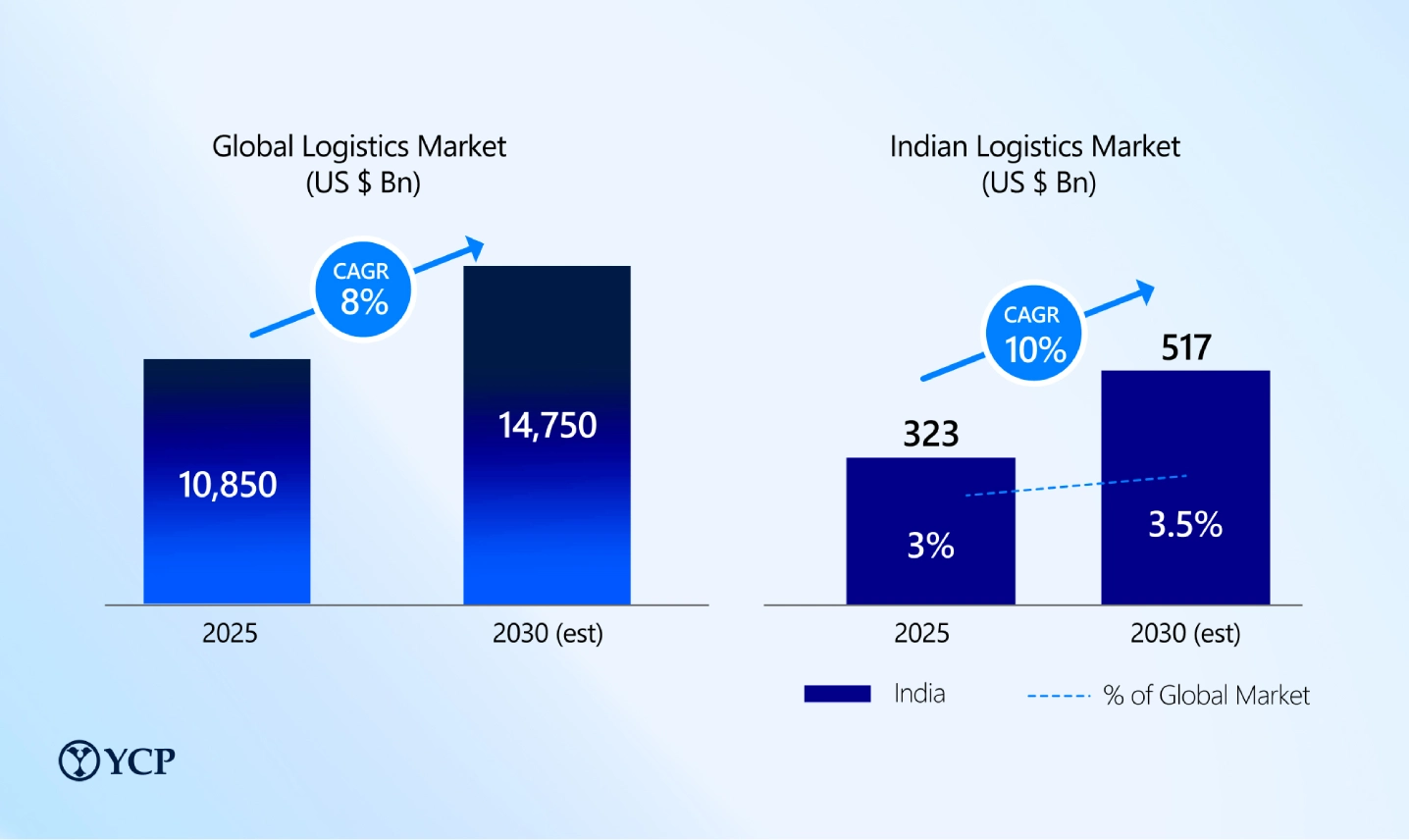
India's logistics market is on track to expand to over USD 500 billion by 2030, growing faster than the global average as consumption, manufacturing, and e-commerce accelerate together. YCP’s white paper, “India's Logistics Industry: Mapping Growth and Value Creation Pathways,” projects the sector will grow at roughly 10% annually through the decade, outpacing global logistics growth of around 8%.
Looking past the growth numbers, a different story emerges. India's logistics market remains largely fragmented, informal, and small-scale at its core. The opportunity is real, but the infrastructure is not yet built to match it.
The Scale of the Problem
The trucking sector illustrates the challenge most clearly. Around 75% of India's road freight capacity sits with operators running five trucks or fewer, while only about 10% belongs to fleets of more than 20 vehicles. The consequences show up in efficiency numbers: Indian trucks average just 300 kilometers per day, compared to 500 to 800 kilometers in more mature markets. Fragmentation has a measurable cost.
Warehousing tells a similar story. Around 90% of storage facilities are run by small, unorganized players. India's distribution infrastructure currently stands at roughly 238 million square feet of Grade A stock, a fraction of China's institutional-grade capacity of over 1,400 million square feet. That gap signals how much of the market remains underleveraged, and how much room logistics infrastructure in India has to grow.
That gap signals how much of the market remains underleveraged, and how much room logistics infrastructure in India has to grow. It also signals something else: where there is this much fragmentation, there is an equally large opportunity for whoever moves to organize it.
Why Fragmentation Is Also the Opportunity
The cracks in India's logistics market haven't gone unnoticed. Consolidation is already underway, and the early moves are telling. Major logistics providers are acquiring competitors rather than building scale organically — absorbing fragmented players to accelerate network reach and drive down operating costs. Terminal operators are extending into end-to-end logistics services, using existing cargo relationships as the foundation for broader value chain integration.
India's supply chain investment is showing up most visibly on the infrastructure side. Institutional warehouse stock tripled between 2019 and 2024, as private equity funds, REITs, and global developers began treating Grade A warehousing the way they once treated airports and toll roads — as a core, long-term asset class. Meanwhile, digital freight platforms have quietly onboarded over one million trucks, pulling fragmented operators into organized networks without requiring outright ownership.
The pattern is consistent across each of these moves. Where the market is scattered, whoever brings structure captures the margin.
How Consolidation is Playing Out
The logistics sector opportunities in India are crystallizing around two distinct routes, each suited to a different type of player and a different part of the market.
The first is digital aggregation. Freight matching platforms are drawing fragmented, small-fleet operators into organized networks, improving load visibility, reducing empty return trips, and creating data trails that make the sector legible to institutional capital for the first time.
The second is logistics M&A in India, which is accelerating as larger players move to close capability and coverage gaps through acquisition rather than organic growth. The targets vary across regional operators, specialist cold chain providers, and express delivery networks, but the underlying logic is consistent. India's logistics value chain is long and complex, and selective, adjacency-led acquisitions have emerged as the more disciplined path toward integration and scale.
What Comes Next
The Indian logistics market outlook points firmly in one direction. Demand will keep growing, trade agreements will deepen export volumes, and e-commerce will continue pushing logistics infrastructure into parts of the market it hasn't reached yet. The structural tailwinds are not in question.
What is in question is who is positioned to capture the value when it arrives. The players best placed to win are not necessarily the largest or the fastest growing. They are the ones with the clearest view of where they sit across the value chain and the discipline to build toward it deliberately.
For a deeper look at how growth, fragmentation, and consolidation are reshaping India's logistics sector, YCP's "India's Logistics Industry: Mapping Growth and Value Creation Pathways" maps the full opportunity landscape across infrastructure, distribution, and logistics services.