AI tools can become part of everyday work while plans for wider deployment remain difficult to execute. Among the most persistent enterprise AI implementation challenges is securing the computing capacity and reliable power needed to support expansion.
YCP’s white paper, “Global Operations in an Era of Structural Recalibration”, examines how semiconductor availability, energy supply, and grid capacity increasingly shape where and how AI can scale. Hardware procurement and infrastructure development can follow longer timelines than software implementation. Closing that gap requires companies to align their AI ambitions with the physical capacity available to support them.
Why Scaling Stalls
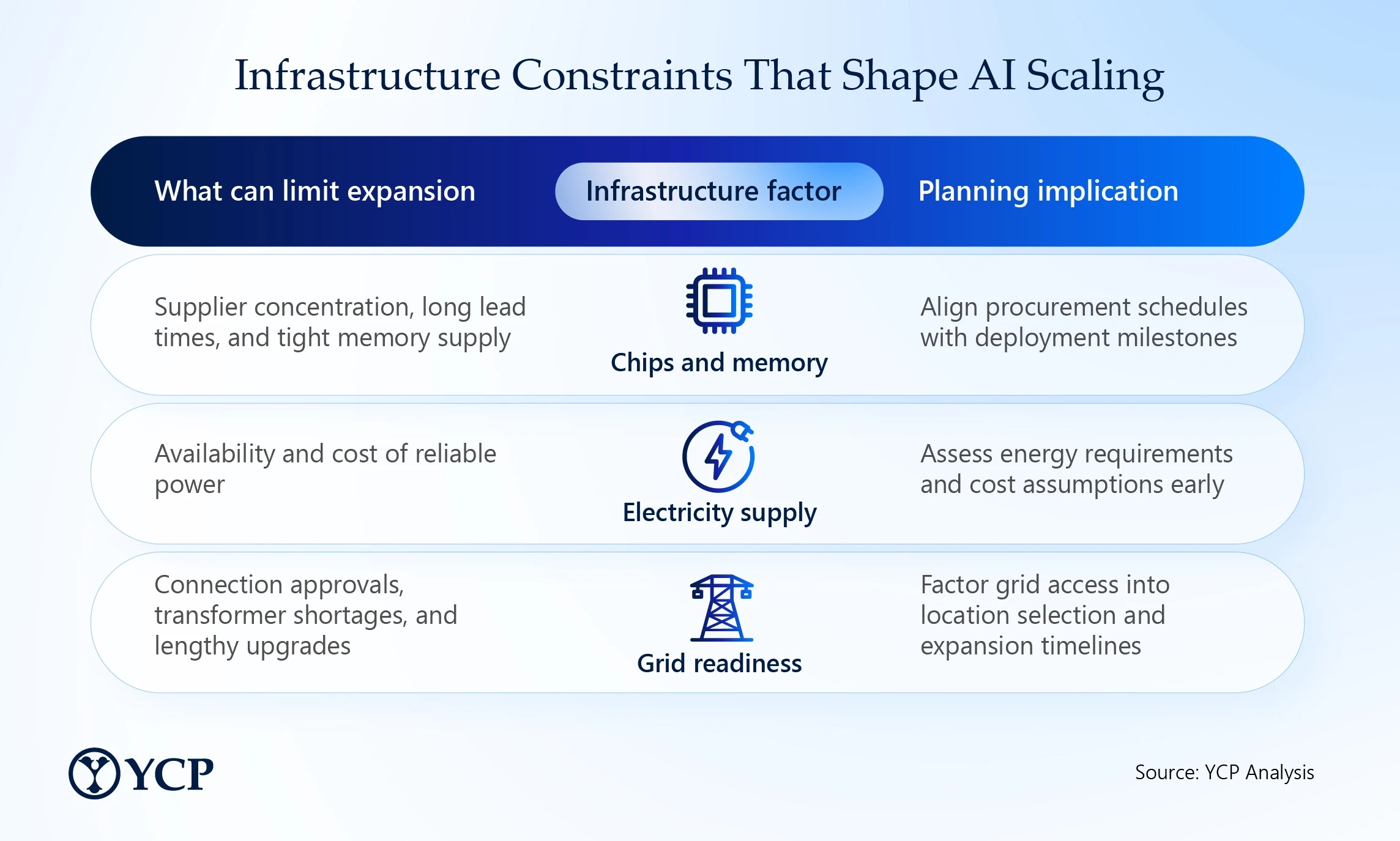
Infrastructure bottlenecks in AI deployment emerge when expansion plans move faster than the systems supporting them. Advanced chip production remains concentrated among a limited number of suppliers, while long lead times and tight supplies of high-bandwidth memory can constrain access to computing capacity.
Power availability creates another obstacle. Large-scale AI requires a stable electricity supply, but grid upgrades and transmission expansion take years. Transformer shortages and connection approvals can delay capacity even where investment is available.
These dependencies make deployment schedules harder to control. Software may be ready while the hardware or power required for wider rollout remains unavailable.
Infrastructure Readiness Shapes Expansion
These constraints influence where companies expand, how quickly they deploy, and what returns they can expect. A location’s appeal increasingly depends on reliable power, grid access, and proximity to semiconductor ecosystems alongside traditional cost considerations.
The white paper describes how major technology firms are securing supply through long-term power purchase agreements, co-located generation, and dedicated renewable investments. These approaches bring energy planning into decisions about digital expansion.
For enterprises planning AI investment, the implication is to assess infrastructure readiness early. Hardware pricing and electricity costs can alter investment assumptions, while procurement and grid connection timelines can affect when capacity becomes operational. Accounting for these factors gives leaders a more realistic basis for setting deployment milestones and evaluating expected returns.
What Leaders Should Assess
Before expanding AI deployment, leaders should examine whether their plans account for the infrastructure needed to deliver results. Three questions provide a practical starting point.
Which business outcome should improve? Define the intended result before selecting or expanding a use case. Shorter turnaround times, lower processing costs, or fewer errors provide a clearer basis for evaluation than usage rates alone. Establish a baseline and measurable targets so teams can assess whether the initiative delivers the expected improvement.
Which infrastructure dependencies could delay delivery? Identify the computing capacity, hardware supply, and power availability required for expansion. Assess supplier lead times and whether the intended location can support projected demand. Where additional grid capacity or connections are needed, incorporate those requirements into deployment milestones.
Do timelines and costs reflect available capacity? Test investment assumptions against hardware procurement schedules, electricity costs, and infrastructure development timelines. Consider how delays or price changes would affect expected returns. Coordinate technology, procurement, finance, and location decisions so that commitments reflect the conditions under which deployment can proceed.
Together, these questions help leaders assess whether an AI initiative has the physical capacity and investment plan needed to deliver sustained value.
Aligning AI Ambition with Infrastructure Readiness
Sustained returns from AI depend on how effectively companies align deployment plans with the infrastructure supporting them. Leaders who account for hardware availability, reliable power, and realistic expansion timelines give their investments a stronger foundation for delivering business results.
For a broader view of how technology, capital flows, trade, and infrastructure are reshaping business decisions, explore YCP’s white paper, “Global Operations in an Era of Structural Recalibration”.