
Most organizations monitor financial performance closely, tracking revenue, costs, and margins with regular reporting and structured oversight. Some of the most significant drains on profitability, however, are not visible in financial statements or executive dashboards. They are embedded in how work is planned, executed, and managed across the value chain.
YCP Renoir's white paper, Operational Transformation Analysis, identifies this as a critical gap. Organizations investing in business process transformation often focus on improving specific processes or functions, but when the broader system remains misaligned, the underlying inefficiencies and the financial costs they generate tend to persist regardless of how much is invested in improvement initiatives.
Understanding what that misalignment is costing is the first step toward meaningful operational efficiency improvement.
When Inefficiency has a Price Tag
The financial consequences of operational misalignment are more significant than many organizations recognize. Poor collaboration alone is estimated to cost the global economy approximately USD 438 billion in lost productivity, and firms absorb an additional burden by increasing net working capital by approximately 6% annually in response to supply chain disruption risk. These costs reflect limited operational visibility rather than deliberate financial strategy.
Perhaps most telling is the gap in organizational performance assessment across industries. Only around 7% of companies have reached a genuine level of operational excellence, meaning the vast majority continue to struggle with embedding disciplined execution and achieving the kind of cross-functional alignment that drives sustainable results. For most organizations, the cost of that gap is real, recurring, and largely unexamined.
Where the Money is Actually Going
For most organizations, operational losses do not appear as line items in financial reports. They accumulate gradually across the value chain, in the delays between functions, the rework generated by unclear handoffs, the underutilization of assets and workforce capacity, and the working capital tied up in processes that move more slowly than they should.
Several core areas consistently emerge as sources of value leakage. Productivity and throughput losses often stem from process bottlenecks and fragmented workflows that have developed incrementally over time rather than through deliberate design. Asset and resource utilization gaps, reliability costs, and unplanned downtime compound these losses further, often going undetected because planning processes appear functional on paper even when execution discipline breaks down in practice.
What makes these losses difficult to address is that they rarely surface through standard reporting or system dashboards. An operational excellence framework applied at the point of execution, where work actually happens, is often what is needed to surface these patterns and quantify their true financial impact. This is where a structured business diagnostic tool becomes valuable, not as an audit mechanism, but as a means of replacing assumptions about performance with observable evidence.
Visibility is the First Step to Recovery
Recognizing where value is being lost is only part of the challenge. The more important question for leadership teams is what that visibility makes possible. When organizations gain a clear, fact-based understanding of how work flows across their value chain, they are better positioned to quantify improvement potential and prioritize initiatives with greater confidence.
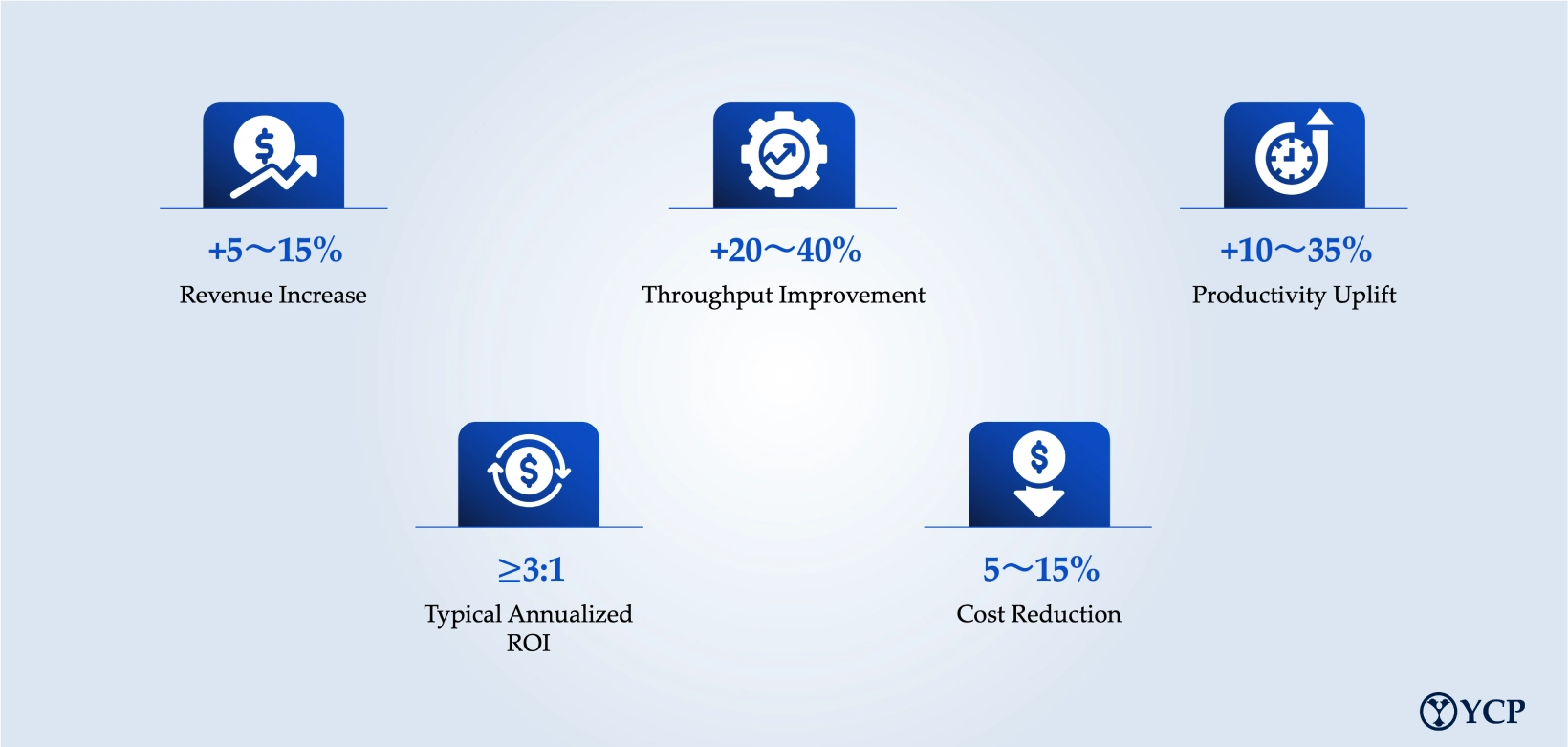
The financial opportunity is significant. An enterprise transformation approach that addresses the structural and behavioral drivers of underperformance can deliver productivity uplifts of 10 to 35%, throughput improvements of 20 to 40%, and cost reductions in the range of 5 to 15%, according to the white paper. Realizing these outcomes, however, depends on operational readiness assessment — evaluating not just where inefficiencies exist, but whether the management systems, workflows, and team capabilities are aligned well enough to support a business transformation strategy that connects operational findings to financial and strategic objectives.
From Financial Risk to Competitive Advantage
Operational inefficiency is often framed as an execution problem, something to be managed through process improvements or technology investments, but when misalignment across the value chain goes unaddressed, the costs accumulate in ways that erode margins, constrain growth, and limit an organization's ability to respond to competitive pressure. Organizations that take a more structured approach to understanding their operational performance are better positioned to turn that dynamic around, moving from absorbing the cost of inefficiency to actively recovering it through a clear business transformation roadmap.
For a deeper look at how organizations can identify performance gaps across the value chain and translate operational insights into measurable financial outcomes, read YCP Renoir's white paper, "The Operational Transformation Analysis Approach: Revealing Performance Gaps Across the Value Chain."