Organizations today face mounting pressure to improve efficiency, reduce costs, and respond more quickly to changing market conditions. As a result, business process transformation has become a priority for many organizations seeking to improve performance and remain competitive.
However, transformation efforts do not always deliver the expected results. In many cases, the challenge is not a single inefficient process but a broader disconnect across the value chain. YCP Renoir's recent white paper, “The Operational Transformation Analysis Approach: Revealing Performance Gaps Across the Value Chain,” reveals performance gaps often emerge when strategy, systems, processes, and people operate out of sync, limiting operational efficiency improvement and slowing progress toward broader business objectives.
Why Process Improvements Often Fall Short
Organizations often approach transformation by targeting specific pain points. A company may invest in new technology to streamline workflows, redesign a business process, or launch initiatives aimed at improving productivity within a particular function. While these efforts can generate positive results, they do not always address the underlying causes of operational inefficiencies.
Many performance challenges emerge at the points where functions, systems, and teams intersect. Processes that work well within individual departments can become fragmented when handed off across the broader value chain. Unclear ownership, siloed decision-making, inconsistent ways of working, and disconnected systems can create delays, rework, and inefficiencies that are difficult to identify through traditional performance metrics alone.
As a result, organizations may optimize individual activities while overall performance remains unchanged. Sustainable operational efficiency improvement requires looking beyond isolated processes and understanding how work flows across the organization as a whole.
Looking Beyond Individual Processes
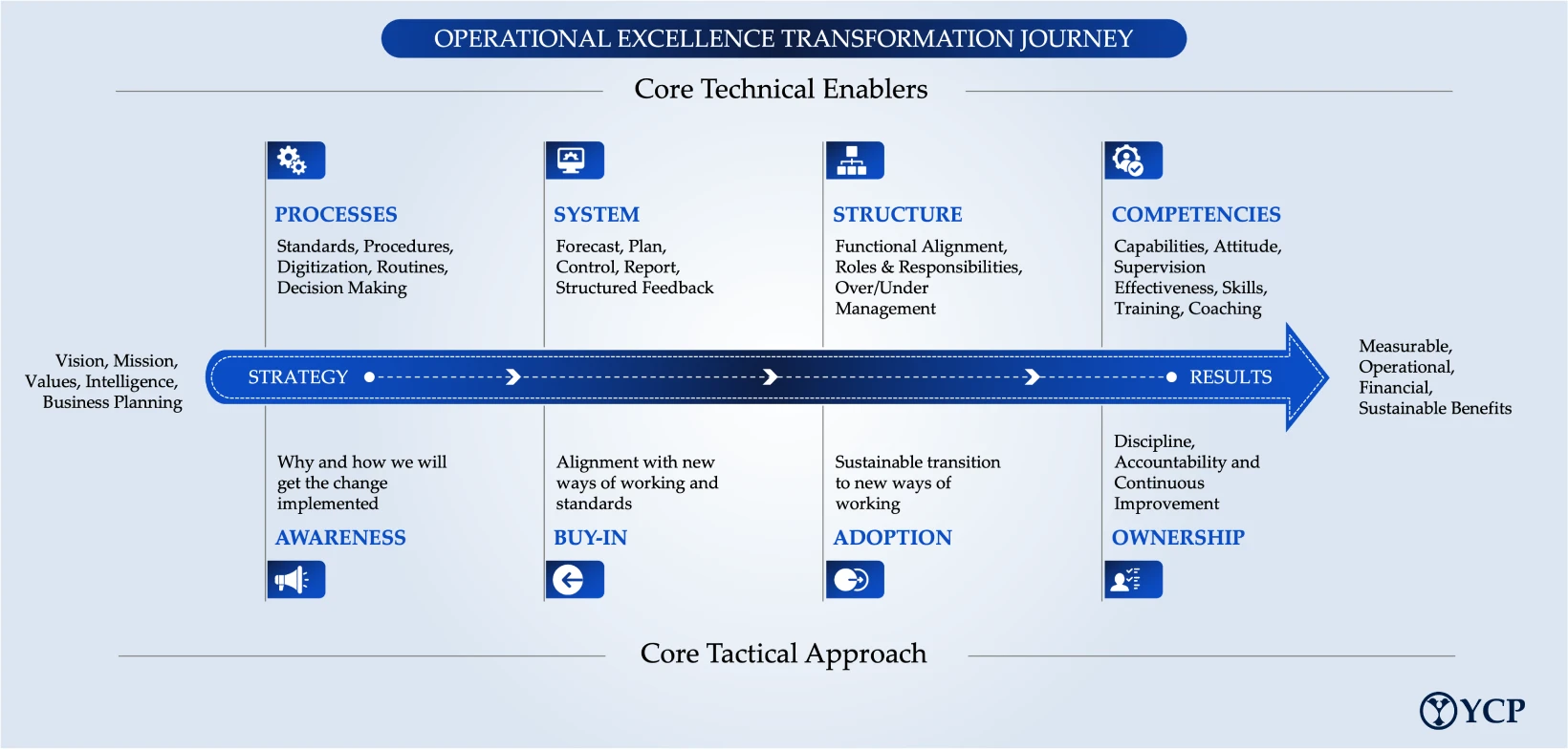
To address performance gaps effectively, organizations need to examine more than individual processes. Operational performance is shaped by a combination of factors, including management practices, organizational structures, technology, and employee behaviors. When these elements are aligned, they reinforce one another and support consistent execution. When they are not, inefficiencies can persist despite significant investments in improvement initiatives.
This is where an operational excellence framework can provide value. Rather than focusing on isolated issues, it enables organizations to evaluate performance across the entire value chain and identify the structural factors limiting results. By taking a broader view of how work is planned, executed, and managed, leaders can uncover hidden sources of value leakage and prioritize improvements with greater confidence.
The goal is not simply to improve individual processes, but to create alignment across the systems, functions, and people responsible for delivering results.
From Diagnosis to Action
While identifying inefficiencies is essential, organizations create value only when insights are translated into clear priorities, defined ownership, and measurable actions. Without a structured approach to implementation, even the most thorough assessments of risk becoming reports that generate discussion but little change.
An effective analysis helps organizations determine where value is being lost, which issues have the greatest impact on performance, and where improvement efforts should be focused first. This allows leaders to distinguish between quick wins that can deliver immediate results and longer-term initiatives that require deeper structural change.
These insights can then be used to build a practical business transformation roadmap that aligns operational priorities with strategic objectives. By sequencing initiatives based on impact, feasibility, and organizational readiness, organizations can improve execution, reduce transformation risk, and create momentum for sustained performance improvement.
Why Alignment Matters
Organizations that take a holistic view of performance are better positioned to identify hidden inefficiencies, strengthen alignment, and drive operational efficiency improvement. By combining a clear understanding of operational realities with a structured approach to execution, leaders can create lasting value and build transformation programs that deliver measurable business outcomes.
For a deeper look at how organizations can identify performance gaps across the value chain and translate insights into action, read YCP Renoir’s white paper, “The Operational Transformation Analysis: Revealing Gaps Across the Value Chain.”