Indonesia’s mining industry is entering a decisive turning point. Over the past decade, the sector has been fueled by strong commodity cycles, aggressive production expansion, and downstream industrialization policies. Today, Indonesia has established itself as one of the world’s most strategically important mining economies.
According to the United States Geological Survey (USGS), Indonesia accounted for more than 60% of global nickel production in 2024, producing approximately 2.2–2.3 million metric tons annually and reinforcing its dominance within the global EV battery supply chain. Meanwhile, coal production exceeded 830 million tons in 2024—significantly above the government’s RKAB (Work Plan and Budget) target—while copper, bauxite, and tin output continued expanding alongside downstream smelter development initiatives. Indonesia’s mineral and coal sector generated more than USD 14 billion in non-tax state revenue (PNBP) during 2024, while mining-related exports remained among the country’s largest contributors to foreign exchange earnings. In parallel, investment realization in the downstream mineral sector exceeded approximately USD 36 billion in 2025, reflecting the government’s long-term ambition to transform Indonesia from a raw commodity exporter into an integrated industrial powerhouse.
In many respects, Indonesia has already won the scale game. The country has successfully leveraged its resource base to attract global capital, accelerate downstream industrialization, and strengthen its strategic position within global supply chains linked to energy transition minerals.
However, beneath these strong macroeconomic indicators, a more structural challenge is beginning to emerge. The next phase of competitiveness in mining may no longer be determined solely by reserve ownership or production scale, but by operational intelligence, execution discipline, and the ability to sustain profitability under increasingly volatile market conditions.
Globally, mining companies are already facing margin compression despite historically high production volumes. Industry studies continue to highlight rising operational cost pressures driven by energy prices, labor shortages, equipment inflation, logistics constraints, and declining ore quality. In Indonesia specifically, operational complexity has increased substantially as mining companies expand into integrated downstream ecosystems involving smelters, industrial parks, captive power systems, and export-oriented processing infrastructure.
Across many mining operations, substantial value leakage still occurs through fragmented operational visibility, low equipment utilization, excessive idle time, unplanned downtime, fuel inefficiencies, weak contractor oversight, and poor synchronization across mine planning, dispatch, hauling, stockpile management, logistics, and processing activities. Studies estimate that advanced operational excellence and digital mining initiatives can improve mining productivity by 15–20%, reduce maintenance costs by 10–40%, and increase asset utilization by up to 20%.
Yet many operators still struggle to integrate operational data into real-time decision-making environments. In practice, companies often continue adding production capacity while underlying operational inefficiencies remain unresolved, creating the illusion of growth while operational resilience and margin quality gradually deteriorate beneath the surface.
This transition is becoming increasingly critical as commodity markets enter a more uncertain environment. Reuters recently reported that Indonesia’s nickel sector is facing mounting pressure from oversupply concerns and weakening global prices following rapid smelter expansion and production growth. Benchmark nickel prices have fallen by more than 40% from their 2022 peaks, placing pressure on operators with weaker cost structures and inefficient operating models. At the same time, Indonesia’s coal industry is beginning to face longer-term structural pressure from global energy transition policies, carbon reduction commitments, and softening export demand across several major markets. These developments suggest that future competitiveness will depend less on favorable commodity cycles and increasingly on operational agility, cost discipline, productivity optimization, and execution quality.
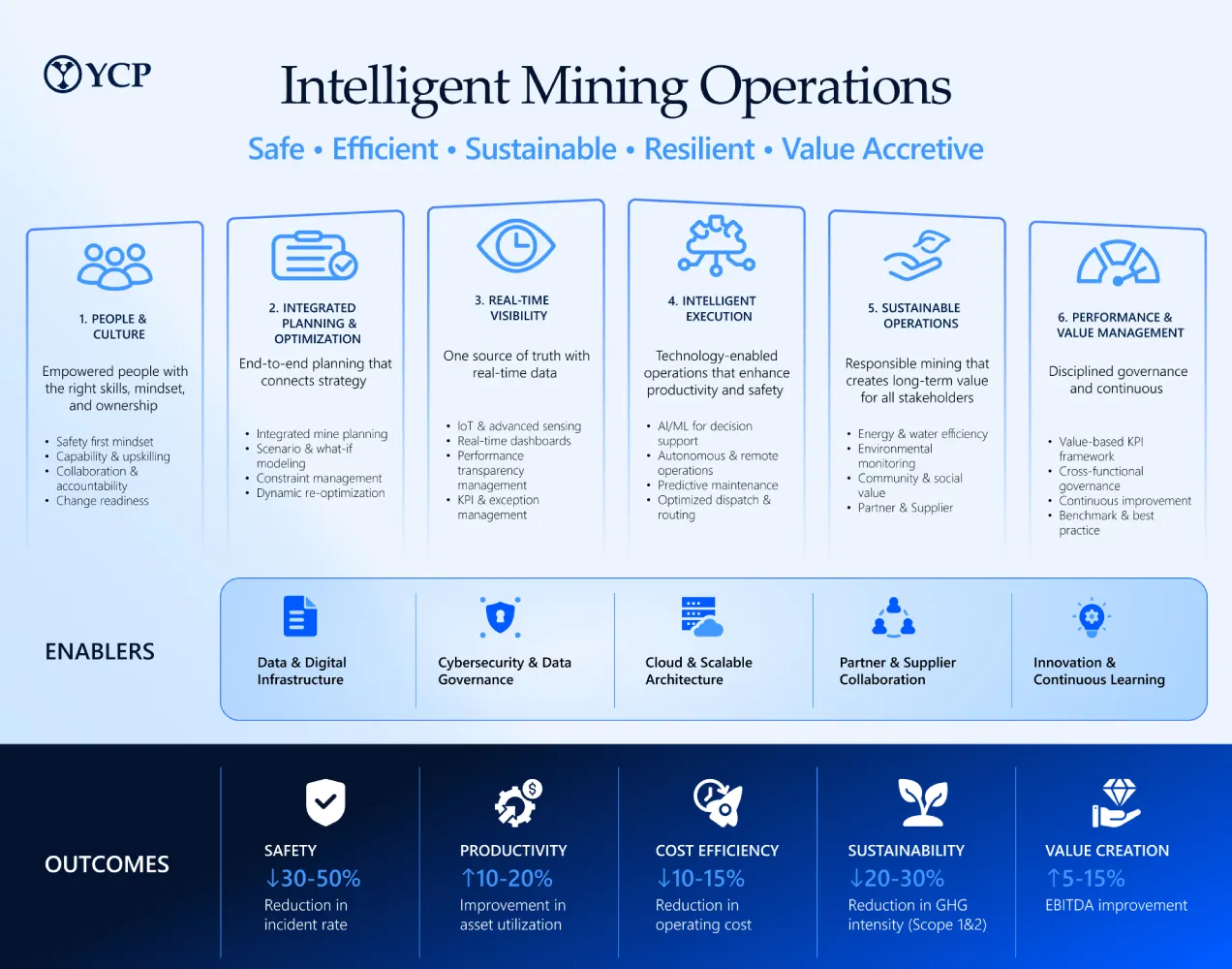
The Rise of Intelligent Mining Operations
As a result, mining itself is evolving into a far more technology-driven industrial ecosystem. The conversation is no longer simply about digitalization for presentation purposes, but about how technology can directly improve operational responsiveness, productivity, sustainability, and profitability.
Leading mining operators globally are increasingly deploying integrated operational control towers, AI-assisted dispatch optimization, predictive maintenance systems, IoT-enabled fleet monitoring, autonomous hauling systems, drone-based mine surveying, digital twin simulations, and real-time production analytics to improve decision-making across the mining value chain. Industry reports estimate that predictive maintenance technologies alone can reduce equipment breakdowns by up to 70% and lower maintenance costs by approximately 25%. Meanwhile, autonomous and semi-autonomous mining operations have demonstrated measurable improvements in safety performance, equipment utilization, and fuel efficiency. Additionally, end-to-end mining digital transformation programs can unlock EBITDA improvements ranging from USD 50 million to more than USD 500 million annually for large-scale mining operators, depending on operational scale and maturity.
Technology is also becoming increasingly important in balancing productivity improvement with sustainability objectives. According to the International Energy Agency (IEA), mining activities account for approximately 4–7% of global greenhouse gas emissions when energy-intensive mineral processing operations are included. In Indonesia, the rapid expansion of nickel processing facilities and captive coal power plants has intensified global scrutiny surrounding environmental sustainability and carbon intensity. As a result, mining companies are facing growing pressure from investors, regulators, lenders, and global buyers to strengthen ESG performance and decarbonization readiness.
Fuel optimization, idle-time reduction, energy-efficient processing, smarter asset lifecycle management, integrated environmental monitoring, and renewable energy integration are now contributing not only to operational cost reduction, but also to long-term ESG competitiveness and access to global markets. Increasingly, operational efficiency and sustainability are converging into the same strategic agenda.
Indonesia’s Next Mining Phase
This marks the beginning of Indonesia’s next mining phase: a transition from resource expansion toward intelligent operations.
In this environment, operational excellence, technology enablement, sustainability, and execution discipline can no longer be treated as separate priorities. The mining companies most likely to lead the next decade will be those capable of integrating operational discipline, data-driven decision-making, technology-enabled execution, ESG-linked productivity, and cross-functional governance into a single scalable operating model.
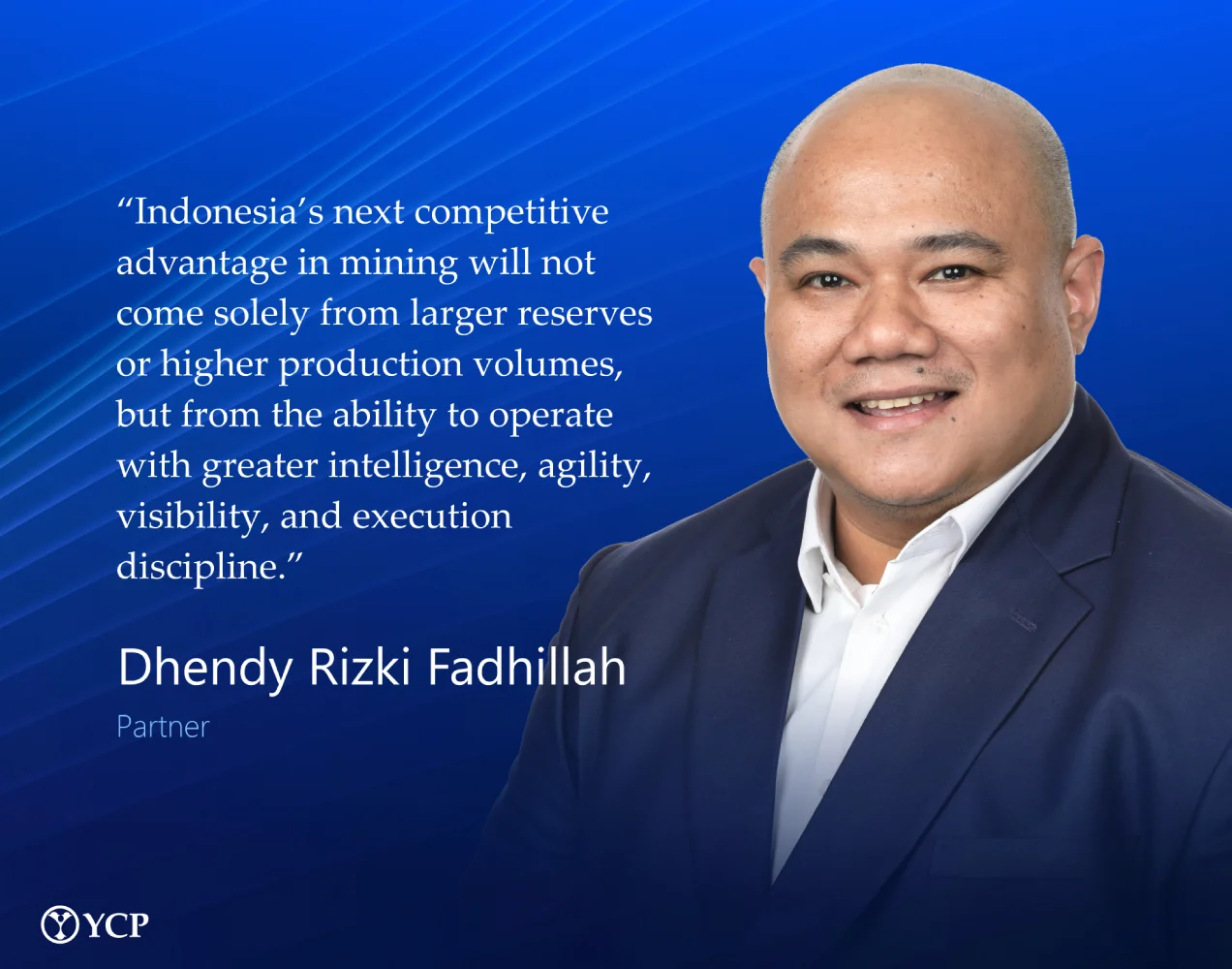
Ultimately, the next competitive advantage in mining may no longer come solely from owning larger reserves or increasing production volumes. It may come from the ability to operate with greater intelligence, agility, visibility, resilience, and execution excellence in an increasingly competitive and complex global industry.