When executives describe the IPO preparation process, the focus is typically financial: audited numbers, a polished equity story, legal documentation in order. Yet across the IPO landscape in Southeast Asia, this framing overlooks a critical reality. An IPO requires coordinated execution across nearly every function in the business — governance, operations, risk, HR, and investor relations — often in parallel, against a fixed regulatory timeline. As the IPO market outlook across the region continues to expand, the companies that struggle are not always the ones lacking financial readiness. More often, they are the ones that never assigned clear ownership of the process as a whole.
Why Coordination Breaks Without a Center
The reason this matters is structural. The IPO preparation process brings together internal teams and external advisors — auditors, underwriters, legal counsel, regulators — each operating on their own timeline and priorities. Without a single function accountable for the full picture, these workstreams tend to progress independently rather than in sync. Deadlines slip because no one is tracking interdependencies across teams. Documentation arrives incomplete because ownership was assumed rather than assigned. Issues that could have been resolved early instead surface late, when they are harder and more costly to fix. This is not a failure of effort or expertise. It is a failure of coordination, and it is one of the most underappreciated risks in the entire IPO journey.
What a PMO Actually Does
This is the gap a Project Management Office, or PMO, is designed to close. Rather than sitting within finance or legal, a PMO functions as a central coordination point across the entire IPO effort, with three core responsibilities.
First, it builds the IPO readiness roadmap: translating the decision to go public into a structured plan that sequences regulatory deliverables, documentation requirements, and organizational milestones in the correct order and against realistic timelines.
Second, it keeps every function and external advisor synchronized. This means tracking interdependencies across workstreams, running regular progress reviews, and flagging bottlenecks before they compound into delays.
Third, it enforces governance over the process itself. A well-structured PMO establishes clear decision-making authority, defined escalation paths for unresolved issues, and quality checks to ensure that outputs, from financial disclosures to investor materials, meet the standard public markets expect.
In short, a PMO does not replace the work of finance, legal, or governance teams. It ensures their work adds up to a coherent, on-time outcome.
The Timeline Reality
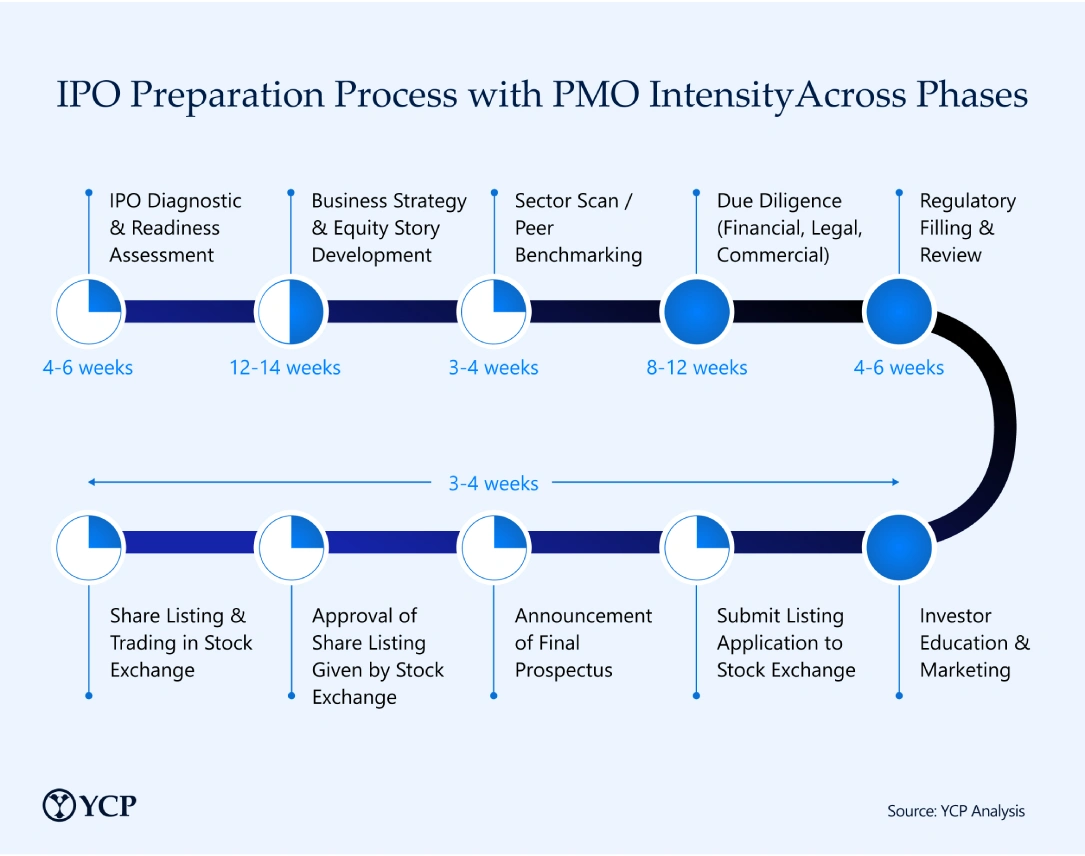
Timing reinforces why this coordination function cannot be an afterthought. An IPO typically takes nine to twelve months from initial readiness assessment to listing, and the majority of that period is spent on internal diagnostics and due diligence, long before regulatory filings or investor meetings begin. The early phases are almost entirely about strengthening internal readiness, while the later phases shift toward regulatory review and investor-facing activity, each with far less room to absorb delays. Companies that wait until closer to the listing date to introduce structured coordination are effectively compressing a process that depends on sequence and lead time. By the time gaps in governance or reporting surface under regulatory review, there is often little runway left to address them without delaying the listing itself.
Practical Takeaway for Executives
For leadership teams evaluating IPO readiness, the practical question is not only "are we ready?" but "who is accountable for getting us there?" A few questions are worth asking early: Who owns the end-to-end roadmap, rather than just their function's portion of it? Who has the authority to resolve conflicts between workstreams when priorities compete? Is there a single point tracking regulatory deadlines against internal readiness gaps in real time? Notably, this coordination function does not have to be built from scratch internally — it can be led in-house, supported by external advisors, or a combination of both. What matters is that the role exists before preparation begins, not after gaps appear.
Readiness Isn't Execution
Ultimately, IPO readiness and IPO execution are two different challenges. A company can meet every financial and governance benchmark and still lose time, credibility, or valuation if no one is coordinating the effort to end. A PMO is what turns a ready company into a public one — on schedule, and without the last-minute scramble that so often defines a poorly run listing.
For a closer look at what IPO readiness requires across Southeast Asia's capital markets, read YCP's white paper, "Southeast Asia IPO Landscape: Building Readiness for Long-Term Success."