As India’s economic growth outlook continues to attract global investment, mid-cap industrial firms are facing rising expectations to scale, innovate, and compete beyond their traditional markets. For many, strategic diversification has become a primary lever for sustaining growth and managing volatility. However, expansion alone no longer guarantees long-term value.
What sets high-performing companies apart is not how widely they diversify, but how they connect their businesses. Rather than building broad portfolios of loosely related assets, leading Indian mid-cap companies are rethinking diversification as a system of integrated products, services, platforms, and capabilities. This shift is reshaping how value is created and defended across competitive cycles.
From Expansion to Integration
Many Indian mid-cap diversification strategies have traditionally focused on adding new business lines, entering adjacent markets, or acquiring standalone assets. While this approach can broaden revenue streams, it often results in collections of businesses that operate in parallel, with limited coordination or shared advantage.
A different model is now taking shape across parts of the industrial landscape. In leading examples of mid-cap stock diversification in India, firms are designing their portfolios around integration rather than accumulation. Products, services, digital platforms, and distribution networks are developed to reinforce one another, creating leverage that fragmented portfolios struggle to replicate.
Pidilite Industries: An Ecosystem Orchestrator
Among the most widely cited diversification case studies in India, Pidilite Industries stands out for how deliberately it has built a connected growth platform around its core strengths. What began as a market-leading adhesives business has gradually expanded into construction chemicals, surface treatments, waterproofing services, and digital channel management, all designed to serve the same contractor and applicator ecosystem.
Pidilite has focused on strengthening the links between these businesses through:
Integrated product portfolios
Digital channel platforms
Contractor training and technical support, and
Financing and ecosystem enablement
Together, these elements deepen customer engagement and reinforce one another across the value chain, helping the company maintain resilience despite input volatility and competitive pressure.
AIA Engineering: A Performance Partner
AIA Engineering offers a different, but complementary, take on how ecosystem thinking can reshape performance in capital-intensive industries. Traditionally known as a supplier of high-chrome grinding media and wear parts, the company has steadily expanded its role within the mining and cement value chain by combining manufacturing with engineering services, process consulting, and localization production.
AIA has focused on strengthening its position through:
Integrated wear parts and linear systems
Engineering and process optimization services
Performance monitoring and technical consulting
Regional manufacturing and supply localization
This shift has allowed AIA to embed itself more deeply in customer operations, strengthen long-term relationships, and reduce exposure to cyclical capital spending, supporting economic growth in Indian mid-cap firms even during slow periods.
Fragmentation vs. Integration: Doing It the Right Way
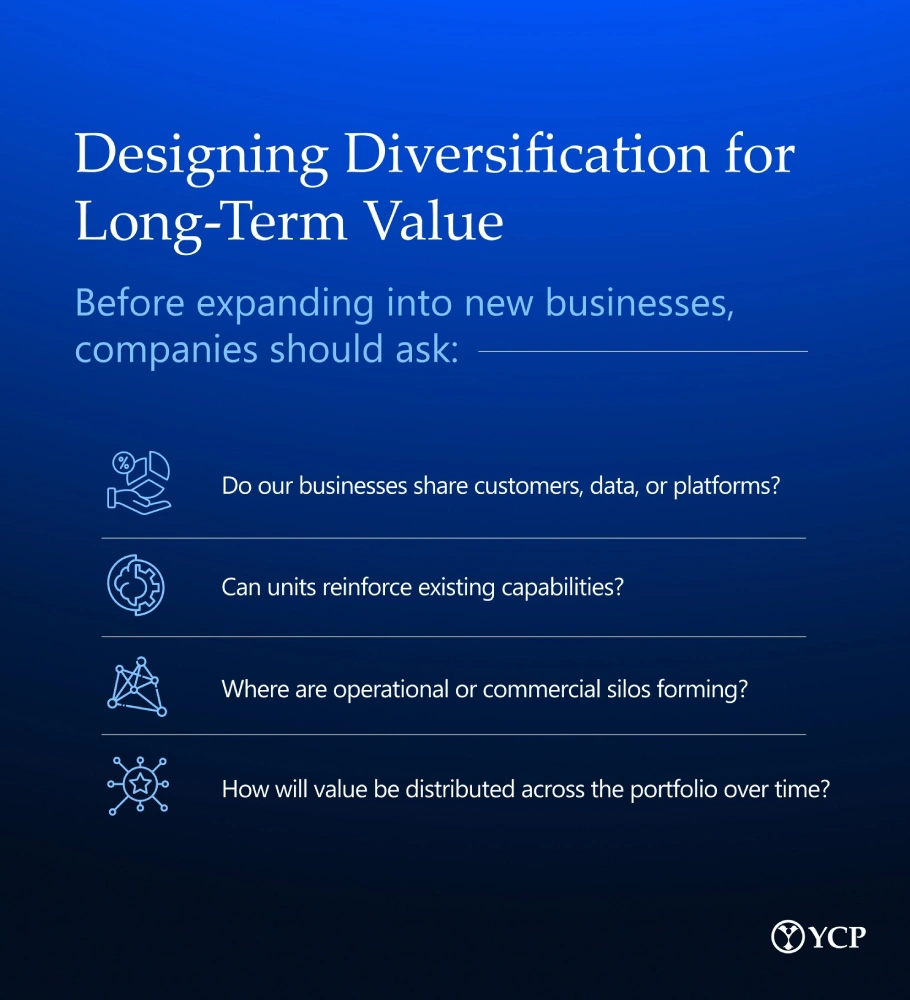
Not all diversification efforts produce durable value. Weaker performers often followed similar patterns: late entry into emerging segments, reliance on standalone acquisitions, and limited integration across business units. Even when strategic intent was sound, fragmented portfolios struggled to generate meaningful synergies.
In contrast, high-performing firms treated diversification as a system-building exercise. They prioritized shared platforms, common customer interfaces, and coordinated capability development, in line with the YCP diversification framework’s emphasis on disciplined portfolio design and internal alignment. Without this system-focused approach, even well-resourced expansion efforts risk becoming sources of complexity rather than advantage.
Enduring Growth and Advantage
The experience of India’s leading mid-cap firms shows that long-term outperformance is rarely driven by expansion alone. Instead, it reflects the ability to design connected systems that link products, platforms, and capabilities into a coherent whole.
When strategic diversification is approached as an exercise in integration rather than accumulation, it becomes a powerful source of resilience and competitive advantage. For leaders looking to navigate the increasingly complex markets, the challenge is no longer how widely you grow, but how thoughtfully that growth is structured.