India’s nuclear sector is undergoing a fundamental transition from a tightly controlled, state-driven system to a more open, investment-oriented market framework.
For decades, nuclear development was intentionally centralized, supported by public funding and domestic capabilities. While this approach established a strong foundation, it was not built to support rapid expansion at scale.
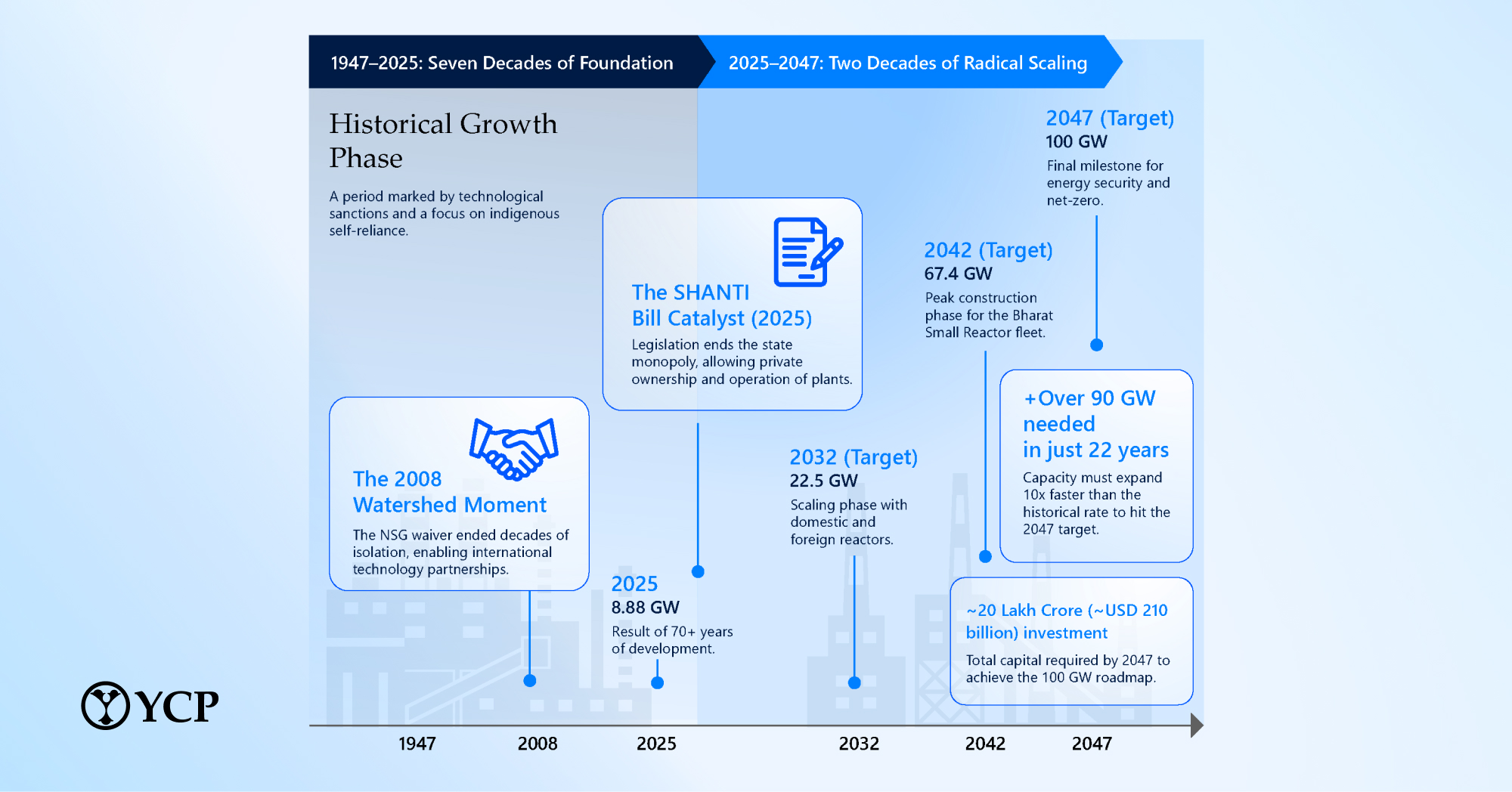
That challenge is now front and center. India has set a target of 100 GW of nuclear capacity by 2047, more than ten times its current base of ~9 GW, requiring an estimated USD 210B in capital. Achieving this level of growth will require a broader pool of capital and execution capacity than the public sector alone can provide.
The SHANTI Act (2025) represents a turning point. The legislation opens the door for private participation in nuclear power generation, allowing companies to own and operate assets while maintaining government control over strategically sensitive areas such as fuel cycles, enrichment, and waste management. The reform marks a major step in India’s nuclear sector privatization efforts.
YCP’s latest white paper, Unlocking India’s Nuclear Sector: Commercial Opportunities Created by the SHANTI Act, analyzes how these reforms are reshaping the sector into a viable infrastructure and investment platform.
The report provides a detailed view of the policy and regulatory changes driving market liberalization, the role of private capital in meeting India’s nuclear expansion goals, and emerging opportunity areas across the value chain.
Drawing on global case studies and India’s evolving policy landscape, this white paper explores how the country’s nuclear sector is opening up to private investment under the SHANTI Act, creating new commercial opportunities in India nuclear energy investment while supporting long-term energy security and decarbonization.
Inside the report, readers can expect to find key insights:
A market in transition: How India is shifting from a state-led nuclear model to a hybrid system that enables private ownership and participation.
A multi-billion-dollar opportunity: Where value lies across generation, industrial applications, supply chains, and financing.
What global markets got right (and wrong): Lessons from the US, UK, Canada, Japan, and Europe on making nuclear investment viable, including the US nuclear private ownership model and Canada’s nuclear concession model.
Why nuclear matters now: Its role as a stable, low-carbon backbone in a renewable-heavy energy mix.
What still needs to be solved: The regulatory, financial, and execution gaps that will determine how fast the sector can scale.
India’s nuclear sector is no longer just strategic; it’s becoming investable. Download the full white paper to see where the real opportunities lie.
Authors
Ashish Sharma
Ashish brings over 25 years of experience across multiple industries, focusing on strategy and digital transformation, with a particular focus on family conglomerates and MNCs.
Ankit Hoshing
Ankit, based in Delhi NCR, has 15+ years of consulting experience across industries like Energy, Transportation, Healthcare, and IT, specializing in strategy, PMOs, and digital transformation.
Recent White Paper
See All