Regionalization has emerged as one of the most significant global supply chain trends as companies seek production networks that are closer to key markets and more responsive to disruption. Yet changing a facility’s location does not automatically resolve the vulnerabilities built into its wider network.
YCP’s white paper, “Resilience by Design: A Strategic Playbook for Nearshoring, Friend-Shoring, and Regional Supply Networks,” examines why effective supply chain regionalization requires more than relocation. If essential inputs, technical capabilities, and logistics routes remain concentrated elsewhere, those dependencies may simply follow production to its new location. Building genuine resilience depends on the ecosystem of suppliers, infrastructure, skilled talent, policy support, and digital coordination surrounding the facility.
Regionalization Is an Ecosystem Decision
A regional supply chain is more than a collection of nearby operations. It is a coordinated system that can source, produce, store, and deliver within a region while remaining connected to global markets. Its strength depends on whether each part can support the others when disruption occurs.
Regionalization is therefore an ecosystem decision, not simply a real estate exercise. A lower-cost location may offer little supply chain resilience if it lacks qualified suppliers, reliable logistics, specialist skills, or a predictable regulatory environment. Leaders must evaluate the capabilities of the entire network rather than the economics of an individual facility.
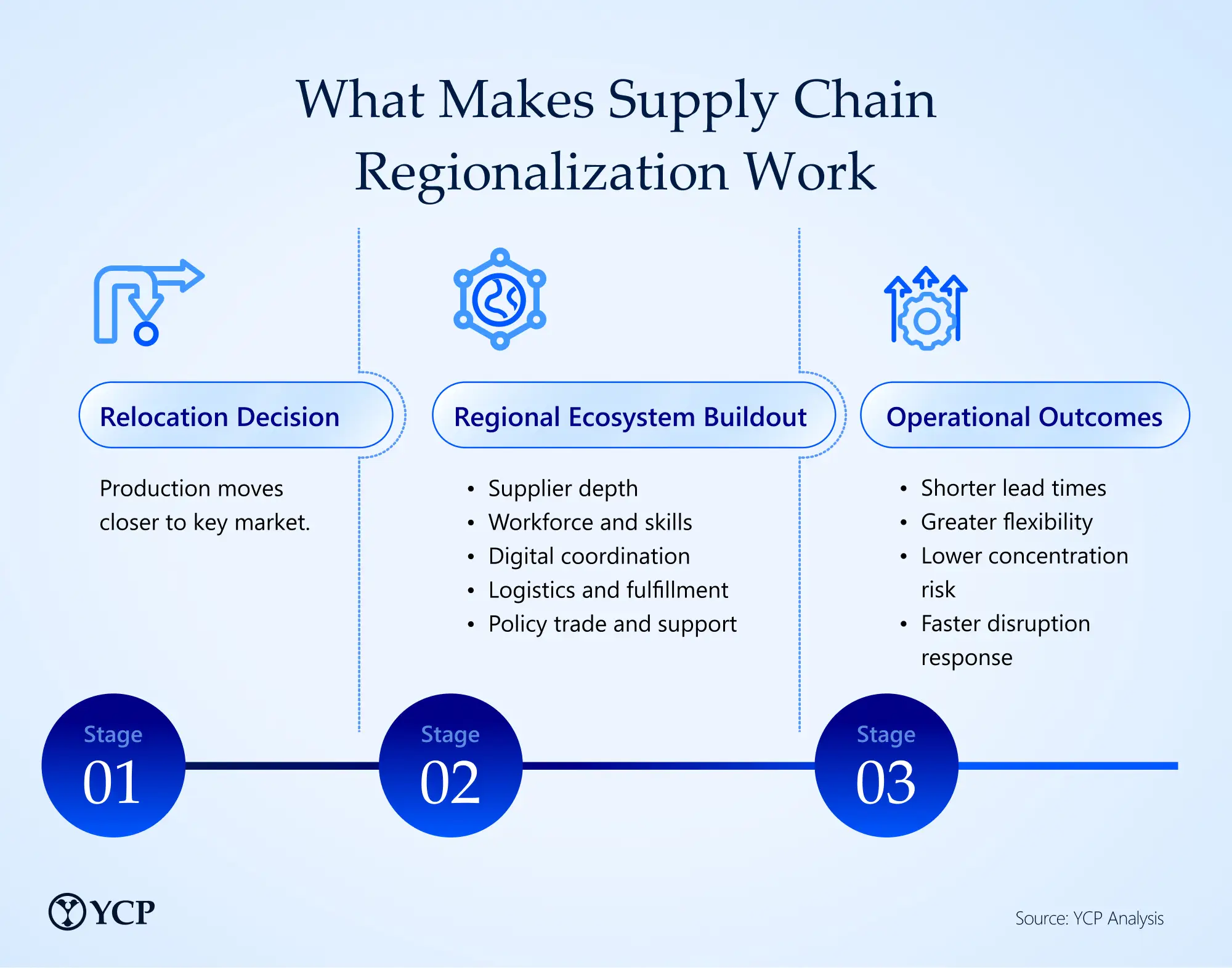
What Makes Supply Chain Regionalization Work
The Building Blocks of a Regional Supply Ecosystem
A resilient regional network depends on several capabilities working together:
Supplier depth: Developing qualified Tier 1, Tier 2, and Tier 3 suppliers reduces reliance on distant sources for critical inputs. This is where supply chain diversification becomes operational.
Logistics infrastructure: Reliable transport routes, distribution facilities, and inventory buffers allow goods to move efficiently across the region.
Workforce capability: Technical, engineering, and digital expertise must be available locally or developed through training and university partnerships.
Policy and digital coordination: Trade agreements and government incentives can reduce operational friction, while shared platforms provide visibility across distributed facilities and suppliers.
European industrial manufacturers offer one example of this approach. By developing closer relationships with Tier 2 and Tier 3 suppliers in Eastern Europe, companies have shortened component lead times and reduced their dependence on distant supply routes. This demonstrates how deeper regional supplier networks can deliver measurable operational gains.
What Leaders Should Assess Before Investing
Before committing capital, leaders should test whether a proposed regional network can deliver the control, flexibility, and responsiveness expected from it. Effective supply chain risk management begins with three questions:
Which dependencies remain? Identify any critical materials, components, technologies, or transport routes that would still rely on distant markets.
Can the surrounding ecosystem support operations? Assess supplier capacity, infrastructure, workforce skills, regulatory conditions, and room for future growth.
Can the network adapt? Determine whether production and inventory can be shifted when demand changes or disruption affects part of the region.
These answers reveal whether regionalization creates genuine operational flexibility or merely replaces one concentration risk with another.
Building Beyond the Factory
The future of supply chain management will be defined not by how quickly companies relocate production, but by how effectively they build the connections around it. Regional networks create value when suppliers, infrastructure, talent, policy, and digital systems operate as a coordinated ecosystem.
For leaders, the priority is to design for adaptability from the outset. Companies that assess the entire network, invest in regional capabilities, and preserve valuable global connections will be better positioned to turn regionalization from a location decision into a durable competitive advantage.
Explore the strategies, frameworks, and industry examples behind this approach in YCP’s white paper, “Resilience by Design: A Strategic Playbook for Nearshoring, Friend-Shoring, and Regional Supply Networks.”