India aims to expand nuclear capacity to 100 GW by 2047, an undertaking that YdCP’s white paper, “Unlocking India’s Nuclear Sector: Commercial Opportunities Created by the SHANTI Act,” estimates will require approximately USD 210 billion in investment.
Under the SHANTI Act, commercial opportunities are opening across nuclear generation and its supporting industries. Turning those opportunities into projects that attract capital will depend on the terms offered to investors and lenders. Predictable revenues, clear responsibilities for risk, and confidence in project delivery will shape whether private participation can support the planned expansion.
Predictable Revenues Come First
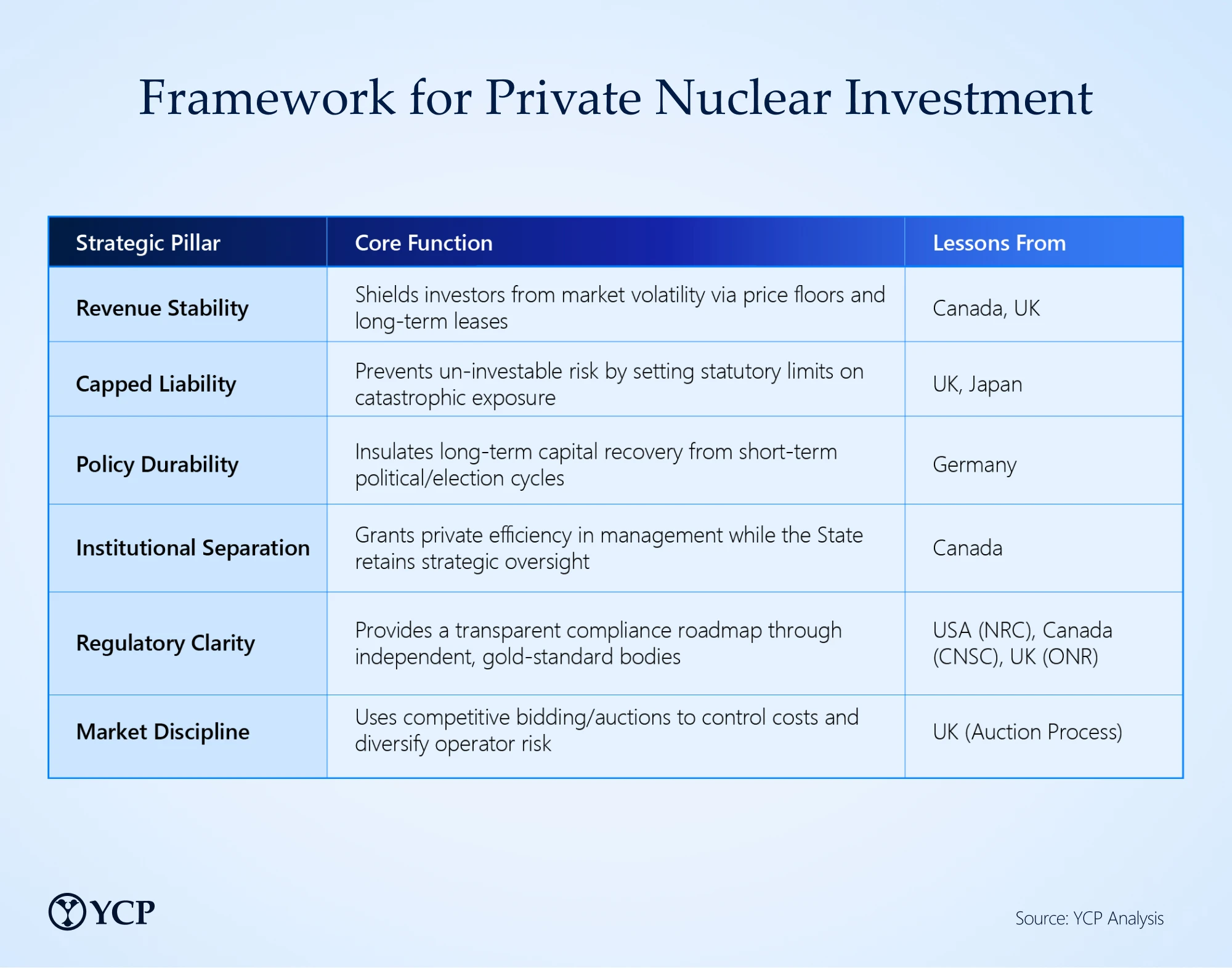
In India, nuclear energy investment will depend on confidence in cash flows over decades. High upfront costs and long recovery periods make projects sensitive to electricity prices, even when plants operate reliably.
The white paper highlights this risk through the US experience, where exposure to competitive wholesale markets left some technically sound reactors financially unviable as electricity prices declined. For investors, reliable generation alone cannot ensure that a project will earn enough to recover its costs.
For India’s initial private projects, the report proposes a transitional Hybrid Annuity Model: fixed government payments covering debt service and defined equity returns. This could give lenders greater confidence in repayment while developers gain experience before moving toward competitive bidding.
Clarifying Who Carries the Risk
The SHANTI Act’s revised liability framework addresses an important barrier to participation by capping operator liability according to reactor size and limiting recourse against suppliers. Yet lenders also need clarity on events that could disrupt repayment.
The white paper identifies a gap in the government’s takeover powers: the framework does not explicitly guarantee continued servicing of senior debt if the state assumes control. It recommends a standardized agreement protecting lenders in that scenario.
Fuel supply and insurance create further uncertainty. Private operators remain dependent on state-controlled fuel-cycle activities, while limited insurance for the reactor core leaves substantial asset value exposed. The report proposes clearer fuel-allocation arrangements and inspections by accredited Indian agencies to help international reinsurers assess risks.
These measures would make potential losses and responsibilities easier to assess, giving lenders a stronger basis for deciding whether to offer long-term financing.
Making Projects Repeatable
Approval delays and component shortages can increase construction costs and postpone the revenues needed to repay debt. The nuclear regulatory framework in India will therefore influence how confidently developers can plan construction and manage costs.
The white paper recommends certifying standardized reactor designs once, while assessing site suitability separately. This would reduce repeated reviews of the same design across projects, helping developers plan a sequence of plants with greater consistency.
Manufacturing capacity needs similar visibility. Fragmented orders make it difficult for suppliers to justify investment in specialized facilities, certification, and skilled teams. The report proposes pooling demand across operators through longer-term procurement agreements, giving manufacturers a clearer view of future orders.
Together, these changes could help developers and suppliers build experience across successive projects. For lenders, a more predictable delivery process would reduce uncertainty around when a plant can begin generating revenue.
What Businesses Should Assess Now
In India, nuclear sector privatization gives businesses a wider choice of roles, from project ownership to specialized manufacturing and services. The practical starting point is to match those roles with their financial capacity, technical capabilities, and tolerance for long-term risk.
Companies assessing entry should use this period to identify suitable partners and build the governance and expertise their chosen role requires. Readiness will depend on both the emerging commercial framework and the organization’s ability to work within it.
Download YCP’s white paper, “Unlocking India’s Nuclear Sector: Commercial Opportunities Created by the SHANTI Act,” to explore the conditions and pathways for private participation.