Indonesia’s downstreaming (hilirisasi) strategy, defined as the policy of processing raw natural resources domestically before export to increase value capture, has fundamentally reshaped its economic structure, transforming the country from a raw commodity exporter into a central player in global industrial supply chains.
Since the enforcement of the 2009 Mining Law and the subsequent tightening of export bans, particularly on nickel in 2020, Indonesia has aggressively pursued domestic processing to capture more value within its borders. The ambition is explicit: shift from extraction to industrialization, and ultimately to global competitiveness in strategic sectors such as batteries and electric vehicles.
From Raw Exports to Processed Dominance
The results are both measurable and striking. Nickel-based exports—including ferronickel (a nickel-iron alloy used in stainless steel), nickel pig iron (NPI) (a lower-cost substitute for refined nickel), and battery intermediates such as mixed hydroxide precipitate (MHP) (a semi-processed material used in battery precursor production)—have surged from approximately USD 3–4 billion in 2017 to more than USD 30 billion by 2022, representing nearly a tenfold increase within five years. Over the same period, the mining and quarrying sector’s contribution to GDP has expanded from around 4–5% to above 9%, reflecting the scale of industrial transformation underway across both extraction and processing.
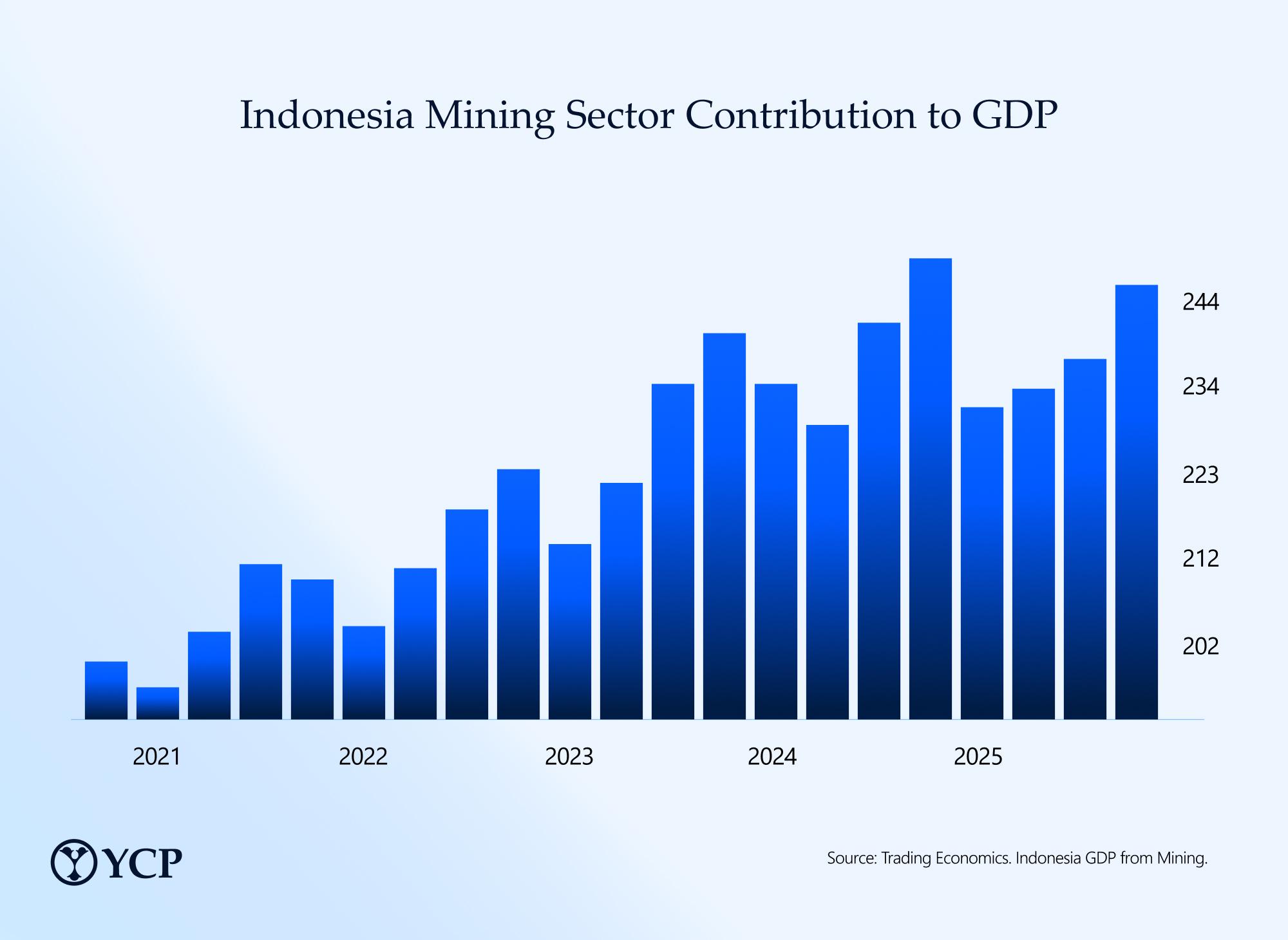
Indonesia now commands roughly two-thirds of global refined nickel supply, where “refined” includes both traditional Class I nickel (high-purity nickel suitable for batteries) and Class II nickel products such as NPI and ferronickel, as well as an increasing share of battery-grade intermediates. This has repositioned Indonesia from a passive price taker to an active market shaper in one of the most critical minerals underpinning the global energy transition. In many respects, Indonesia has already demonstrated that it can win the scale game: mobilizing capital, building infrastructure, and accelerating industrial capacity at a pace rarely seen in resource-driven economies.
This expansion has been supported by substantial investment inflows, with tens of billions of dollars deployed into smelters and High Pressure Acid Leaching (HPAL) facilities, a processing technology used to extract nickel from low-grade laterite ores and convert it into battery-grade materials. Industrial clusters such as Morowali and Weda Bay have rapidly evolved into globally significant metallurgical hubs, driving regional economic growth and employment. Provinces like North Maluku have recorded double-digit GDP growth, underscoring the localized impact of downstream industrialization. The country has effectively compressed what would typically be decades of industrial development into a single policy cycle.
The Value Chain Gap: Processing vs. Value Capture
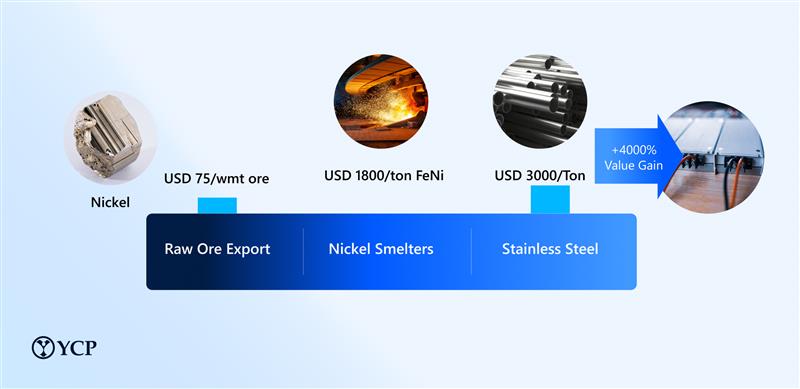
Beneath this strong macroeconomic performance lies a more nuanced structural reality. While downstreaming has succeeded in shifting Indonesia from raw exports to processed outputs, the bulk of value creation remains concentrated in midstream activities, primarily smelting and refining.
The nickel value chain can be broadly divided into:
Upstream: mining and extraction of ore
Midstream: processing and refining (e.g., smelting into NPI/ferronickel or HPAL into MHP)
Downstream: higher-value manufacturing (battery precursors, cathodes, battery cells, and electric vehicles)
Indonesia’s current strength lies overwhelmingly in the midstream. Higher-value segments such as battery cell manufacturing, cathode production, and integrated electric vehicle ecosystems remain underdeveloped. These downstream segments typically capture higher margins, embed technological capabilities, and provide greater strategic control over supply chains.
As a result, Indonesia has moved decisively into processing but has not yet secured leadership in the most value-accretive parts of the chain. The country has transitioned from exporter to processor, but not fully to value chain leader, where margins, intellectual property, and long-term strategic leverage reside.
This gap is further accentuated by the structure of industrial ownership. A significant proportion, estimated at 70–75%, of Indonesia’s nickel processing capacity is associated with foreign investors, particularly from China. While this has enabled rapid deployment of capital and technology, it also introduces a structural trade-off. Industrial activity may be located within Indonesia, but control over technology, financing, and a portion of economic rents (the excess profits generated from resource-based industries) remains partially externalized. Hosting capacity, therefore, does not automatically translate into capturing full value.
Capacity Expansion, Market Pressures, and Sustainability
At the same time, the pace of expansion is beginning to test market dynamics. The aggressive build-out of smelting and HPAL capacity has contributed to concerns of global nickel oversupply, particularly in intermediate products, exerting downward pressure on prices and margins. Policy discussions around production controls have started to emerge, signalling that capacity growth may be outpacing demand absorption. This suggests that the current phase of downstreaming remains heavily capacity-driven, rather than fully optimized for sustainable value creation. The critical inflection point now lies in whether Indonesia can convert this scale advantage into disciplined, value-led growth.
Environmental and institutional considerations further shape this trajectory. Large-scale industrialization in resource-rich regions has introduced tangible environmental pressures, including deforestation, water contamination, and marine ecosystem disruption. At the same time, the complexity of regulatory coordination across multiple stakeholders continues to influence execution consistency. As global markets increasingly incorporate ESG (Environmental, Social, and Governance) criteria into supply chain decisions, these factors will play a defining role in determining Indonesia’s long-term competitiveness and its ability to access premium markets.
Taken together, Indonesia’s downstreaming journey represents a powerful but incomplete transformation. The first phase has been defined by speed, scale, and structural repositioning. The next phase must be defined by depth—moving further downstream, strengthening domestic industrial capabilities, and capturing higher-value segments of the global value chain. In essence, Indonesia’s long-term competitiveness will not be determined by how much capacity it builds, but by how much value it ultimately retains.
Encouragingly, Indonesia enters this next phase from a position of considerable strength. It holds a dominant position in critical minerals, has successfully attracted global capital, and has demonstrated the ability to execute large-scale industrial policy with discipline. With a more deliberate focus on downstream integration, domestic capability building, and ESG-led competitiveness, Indonesia is well positioned to evolve from being the world’s largest processor of critical minerals into a fully integrated industrial powerhouse. The downstreaming story, therefore, is not approaching its limits: it is entering its most strategic phase.