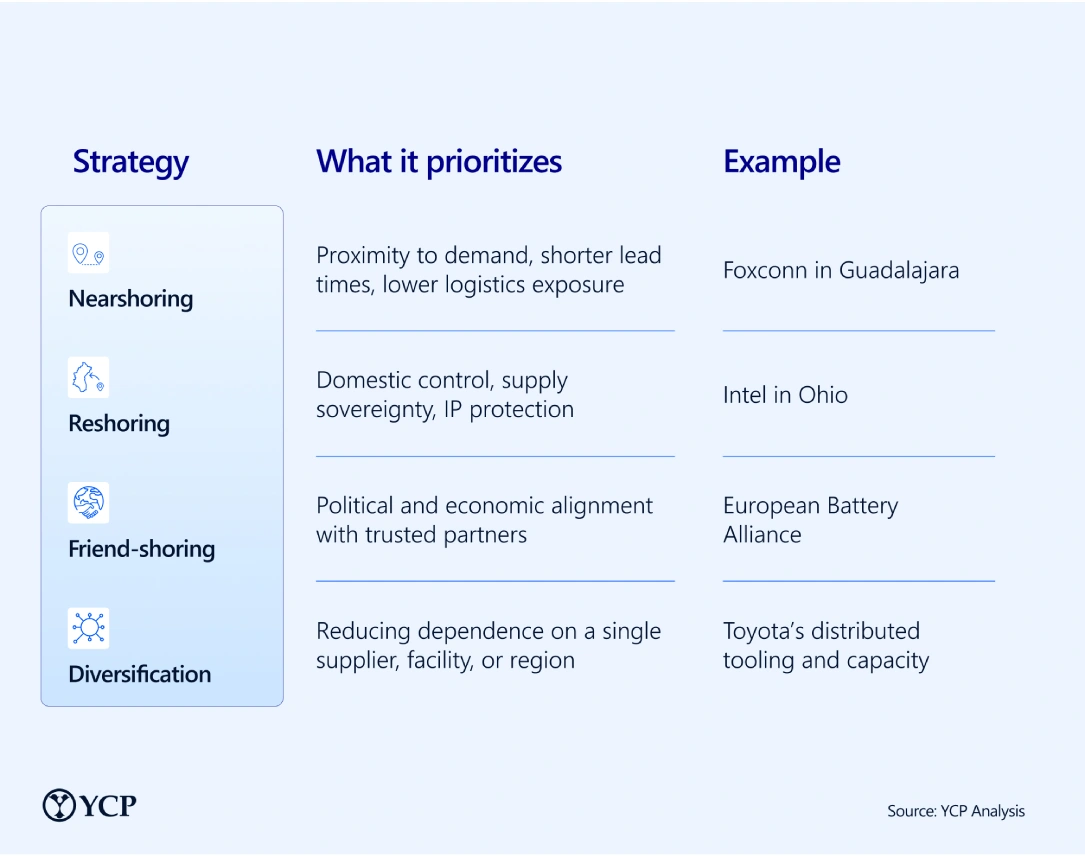
Nearshoring, reshoring, and friend-shoring are often discussed as part of the same shift toward stronger supply chain resilience, but they are not interchangeable strategies. Each respond to a different mix of cost, geographic, operational, and geopolitical considerations. In YCP’s white paper, "Resilience by Design: A Strategic Playbook for Nearshoring, Friend-Shoring, and Regional Supply Networks," these approaches are examined as distinct ways companies can redesign supply networks around different sources of risk. In practice, a nearshoring strategy may prioritize proximity to demand; reshoring can strengthen domestic control, while friend-shoring places greater weight on political and economic alignment.
Nearshoring in Action: Foxconn in Guadalajara
Nearshoring brings production closer to key end markets, but Foxconn’s investment in Guadalajara shows that this is no longer limited to lower-cost assembly. The company is investing approximately USD 900 million to build what the white paper describes as the world’s largest AI server assembly line, producing NVIDIA GB200 Blackwell servers for North American demand. The project reflects a broader shift toward supply chain regionalization, with advanced, high-value manufacturing positioned closer to customers to shorten lead times and reduce exposure to long-distance logistics and trade disruption. It can also strengthen the surrounding regional supply chain by increasing demand for local Tier 1 and Tier 2 suppliers.
Reshoring in Action: Intel in Ohio
Reshoring takes a different approach by bringing production back into the home market. Intel’s approximately USD 20 billion investment in new semiconductor fabrication facilities in Ohio shows how reshoring manufacturing can be tied to strategic control as much as domestic production. The white paper describes the project as Intel’s largest reshoring initiative to date, aimed at strengthening the U.S. semiconductor supply chain and reducing reliance on fabrication capacity in Asia. The facilities are expected to support advanced process nodes for AI, cloud computing, and consumer electronics, highlighting how reshoring increasingly extends to capital-intensive, high-technology manufacturing rather than simply bringing back conventional assembly.
Friend-Shoring: Resilience Through Alignment
Friend-shoring shifts the emphasis from geographic proximity to political and economic alignment. In practice, a friend-shoring supply chain may be built through coordinated relationships between manufacturers, suppliers, governments, and regional institutions rather than through a single factory relocation. The white paper points to the European Battery Alliance as one example, where suppliers, governments, and manufacturers are working across borders to build regional battery capacity and reduce dependence on Asian supply. This makes friend-shoring less about bringing production “home” and more about concentrating critical capabilities within trusted networks.
When Relocation Isn’t the Answer: Toyota
Not every resilience strategy requires moving production to a new country or bringing it back home. Following the 2011 Japanese earthquake, Toyota restructured its supplier network by spreading tooling and production capacity across multiple regions so that disruption at a single supplier would not halt global production. The example shows how supply chain diversification can reduce concentration risk without relying on wholesale relocation. For some companies, resilience may come less from choosing a new geography and more from ensuring that critical capabilities are not dependent on one supplier, facility, or region.
Matching the Strategy to the Risk
The right approach depends on the vulnerability a company is trying to address. Nearshoring may be most useful where lead times and market proximity matter, reshoring where control and domestic capacity are priorities, and friend-shoring where geopolitical exposure is a greater concern. Diversification, meanwhile, can reduce dependence on any single supplier or region. The white paper recommends beginning supply chain risk management with a diagnostic of dependencies, lead times, and geopolitical exposure before testing different network configurations. Resilience is therefore less about following a particular label and more about matching the strategy to the specific risk.
Explore the Full Resilience by Design Framework
Nearshoring, reshoring, friend-shoring, and diversification are only part of a broader approach to building more adaptable supply networks. Download the white paper, "Resilience by Design: A Strategic Playbook for Nearshoring, Friend-Shoring, and Regional Supply Networks," to learn more about these strategies alongside regionalization, digital visibility, supplier collaboration, and practical implementation frameworks.