When the macro picture turns uncertain, the instinct is to freeze: currency moving against the business, financing suddenly more expensive, a new tariff regime still being priced in. The natural board-level reflex is to pause spending across the board and wait for clearer skies.
That is the wrong instinct, applied to the wrong budget line.
Across Southeast Asia right now, that uncertainty is not hypothetical. Indonesia's rupiah has hit record lows this year. Bank Indonesia, the country’s central bank, has pushed its policy rate to 5.75% just to defend it, so the cost of capital has risen for every business in the country, regardless of what that business actually does. A new US tariff arrangement has just reset the economics of exporting into one of the region's largest markets. Thailand's growth has stalled below 2%. The Philippines just had its 2026 forecast cut by more than half a point. This is not a single-country story — it is a regional one. Every management team in Indonesia, Singapore, Malaysia, or the Philippines is looking at a business case that made sense eighteen months ago and questioning whether it still holds.
The reflex follows: cut discretionary spend across the board, with growth capex usually the first casualty — new plant, new market entry, new product lines. That is often the right call. A multi-year growth bet built on last year's assumptions deserves a second look in a currency and rate environment like this one.
The problem is that "discretionary spend" is defined too broadly. Operational excellence work is swept into the same bucket as growth capex, when it is structurally the opposite kind of investment.
Cost reduction doesn't belong in that freeze
The projects we run under the OXD banner labor productivity, contractor cost discipline, working capital, throughput and yield improvement, the operating rhythm that actually gets a plan executed rather than just written, aren't growth bets. They don't need new capital, new debt, or a view on where the rupiah will be in twelve months. They need discipline applied to what a business already owns: its people, its assets, its existing contracts and processes.
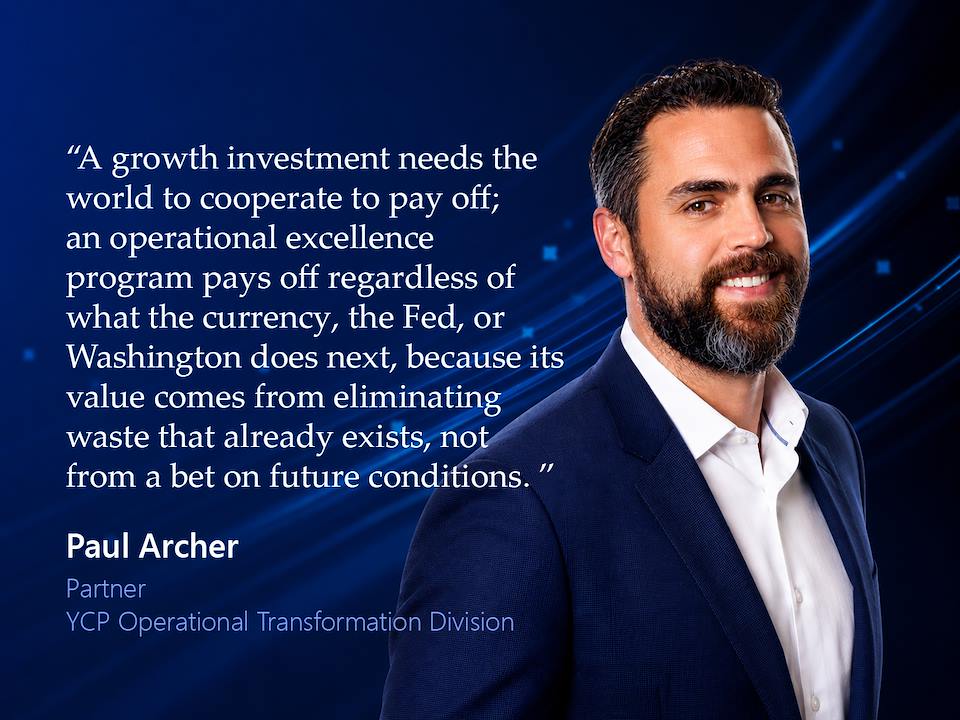
That distinction matters most when financing is expensive and currency risk is elevated. A growth investment needs the world to cooperate to pay off; an operational excellence program pays off regardless of what the rupiah, the Fed, or Washington does next, because its value comes from eliminating waste that already exists, not from a bet on future conditions. In a stable environment, that is a nice-to-have. In an uncertain one, it is nearly the only category of spend a business can commit to with real confidence in the return.
The mechanics are straightforward, which matters when boards are risk-averse. Structured programs built around a disciplined planning and control cycle, a focused improvement process, and real management accountability — rather than a generic "efficiency drive" — typically identify recoverable value of 10 to 20% of the addressable cost base, often within a single quarter of diagnostic and design work. That is not a multi-year payback profile. It is a return that funds itself within the same budget cycle in which it was approved — precisely what a CFO needs when every other line item is under pressure.
The businesses that come out ahead aren't the ones that cut deepest
One pattern is worth naming plainly: the companies that emerge from a period of macro stress strongest are rarely the ones that cut hardest across every function. They are the ones that protected their ability to invest again the moment conditions turned, because they used the downturn to eliminate cost that was never adding value in the first place, rather than cutting muscle along with the fat.
That is the real case for operational excellence work right now, and it is a different case than "save money because times are hard." Uncertainty is exactly when knowing a business's true cost base, its actual productivity, and where its margin is leaking stops being a nice-to-have and becomes a competitive advantage. Businesses that go through that exercise now are not just cutting cost — they are building the visibility and the margin buffer that let them move first once the rupiah stabilizes, rates come back down, and competitors who spent 2026 frozen are still determining what their real numbers even look like.
None of this requires waiting for certainty to return. If anything, it is the opposite: the current environment is reason to examine operational performance more closely, not reason to defer it. The capital-intensive, multi-year bets can wait for a clearer picture. The work of finding the cost and productivity already sitting inside the business cannot wait — every quarter it is deferred is margin left on the table, funded entirely by the business's own inefficiency rather than anyone else's uncertainty.
The businesses navigating this well are not asking whether to spend. They are asking which spend actually needs the world to cooperate, and funding everything else immediately.
About Our Expert
Paul is a Partner at YCP Renoir's Operational Transformation Division, leading Indonesia, Singapore, and Hong Kong. He partners with leadership teams to accelerate performance, growth, and transformation initiatives to deliver tangible results. Paul helps organizations focus on the levers that drive sustainable performance. He supports clients across Asia and global markets, with experience spanning energy, infrastructure, manufacturing, aviation, and financial services.